



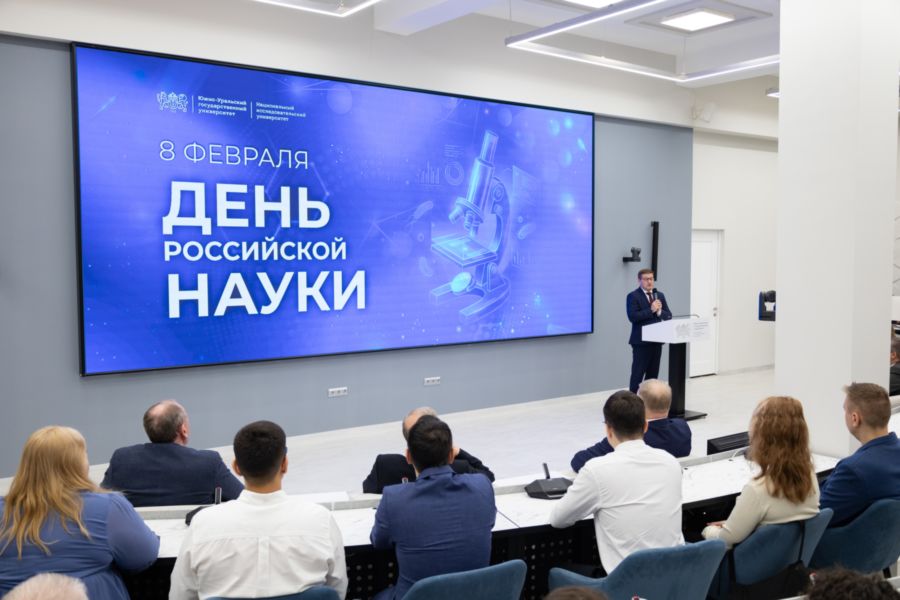
A ceremonial meeting dedicated to the Day of Russian Science has been held at South Ural State University. In the University Council hall, the university’s research community summed up the results of 2025 and became acquainted with ambitious projects planned for the near future.
Opening the meeting, the SUSU Rector Alexander Wagner gave a detailed overview of the broad scope of research studies and highlighted a key trend:
“Our university is truly developing across a wide range of scientific fields. What particularly pleases me is that these areas have begun to intersect very actively, giving rise to interdisciplinary research. This includes robotics, mechanical engineering, transport engineering, and a very large number of groups and projects in the field of artificial intelligence. Research in biotechnology cannot go unnoticed: our scientists have major achievements and strong prospects there. There are many projects in sports science and prosthetics. The university is successfully developing quantum technologies, as well as mathematical modelling in such fundamental and highly complex areas as aerospace engineering, mechanical engineering, and jurisprudence, including digital law.”

The Rector emphasized that digital technologies and artificial intelligence “widely permeate” all areas of science at the university, enriching traditional fields. At the same time, he stressed that the key “locomotive” of development is the advancement of scientific schools. Strengthening work on training candidates and doctors of sciences is credited to the SUSU President.
Aleksandr Shestakov addressed his colleagues and outlined the strategic role of science:
“Today is our professional holiday. But this day is not only for celebration—it is also a moment to look into the future. It seems to me that science is the foundation of our country’s technological development. I would even say more: it is the foundation of national security. The quality of higher education is mostly based on the level of scientific research. Therefore, I would like to wish all departments and all schools to set tasks at a level no lower than the national one, and perhaps even higher.”
In line with these principles—interdisciplinarity and high ambitions—the key presentations were delivered.

First Vice-Rector for Research Anton Korzhov presented the Science at SUSU. Results of 2025 Almanac. A video presentation clearly demonstrated growth in publication activity, increased volumes of grant funding, and successes in implementing strategic academic units. According to Anton Korzhov, in 2025 our university had implemented 70 research projects, including 45 supported by grants from the Russian Science Foundation, 9 state assignments, and 3 projects within the Priority 2030 program.
“The projects are distributed across technical and humanitarian fields. Electronic versions of the Almanac have been available since 2017. In addition, the structure of our university’s research divisions is presented, with descriptions of equipment available to researchers. Inclusion in the Almanac is considered the highest recognition of the SUSU scientists’ achievements,” Anton Korzhov summarized.
Acting Director of the Industrial Robotics Centre Dmitry Shnaider spoke about their record-fast launch. The new university unit will become a focal point for projects at the intersection of mechanical engineering, electronics, and programming, responding to the technological challenges of industry.
In his report, a special guest, Yuriy Chekhovich, Head of Laboratory 42 at the Institute of Control Sciences of the Russian Academy of Sciences and CEO of Domate company, analyzed the role that artificial intelligence technologies currently play in science and education.

“According to recent data, the overwhelming majority of students—more than 92 percent—regularly resort to artificial intelligence services in their studies and research,” Yuriy Chekhovich said. “The number of scientific articles indicating the use of such tools in the writing process is rapidly increasing. The use of modern technologies is quite natural in itself, as students and researchers gain a powerful tool that accelerates work and increases productivity. However, along with these advantages, significant risks emerge. Generative models are effective at producing text, but they are not capable of fully replacing creative thinking and originality of thought. They reproduce existing knowledge rather than create fundamentally new content. The use of artificial intelligence poses threats to the quality of educational processes and creates risks of violations of academic integrity and copyright.”
According to scientists, the higher education system will inevitably undergo transformation in the near future amid the “boom” of artificial intelligence.
The meeting continued with a series of pleasant events, which we will report on later.
Read more in the SUSU channel on MAX